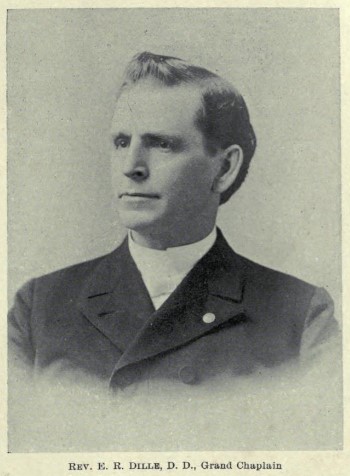
The Rev. E. R. Dillie, D.D was the Second Noble Grand of True Fellowship Lodge in Santa Clara, Calif.. Dillie was also the IOOF’s Grand Chaplain, serving the Methodist Episcopal Church in Santa Clara and beyond. His Doctor of Divinity was conferred by the University of the Pacific.
“What constitutes the supremacy of the 19th Century over all former centuries. Our journalists, orators, and historians call this the crowning century of time. But in what realm lies its supremacy?
Not in education, for our schools produce no scholars equal to Plato or his great teacher, Socrates; not in oratory, for our orators still ponder as their masterpieces and models the periods of the “Oration on the Crown;” not in sculpture or architecture, for the broken fragments of a Paridas or an Angelo are still the models of the plastic art, and at once the administration and despair of artists; not in literature, for this century has produced no Homer or Shakespeare.
Humanity, social sympathy, altruism, brotherhood, are the glory of our age. The application of love to the various departments of human life furnishes the historian with the milestones by which to measure human progress.
Eighty years ago, American Odd Fellowship was born. That sum of years in the individual marks senility and approaching decay, but to an Institution like ours, founded on eternal principles, and destined to be as enduring as the race, those years but mark the period of its infancy, and leave the dew of youth on its brow.
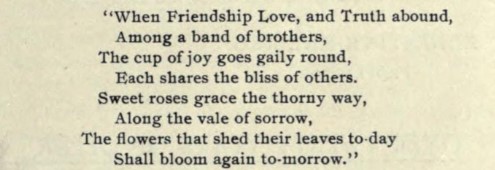
American Odd Fellowship is an evolution from the old English Unity. In the latter part of the 18th Century Lodges or Guilds of mechanics existed in London calling themselves “Ancient and Honorable Odd Fellows”. These Lodges were at first entirely of a beneficial and convivial character. It was customary for each member to pay a penny a week for the relief of the poor among them; and this was the humble origin of our present system of beneficence and relief which stands unequalled in its perfect adaptation to its purpose. The early Lodges were convivial. In the year 1788 the great poet Jjames Montgomery wrote an ode for a Lodge in London, one verse of which I quote:”
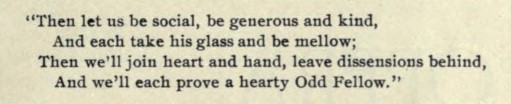
“Another verse of a refrain current in those days was still more bacchanalian:”
“Gradually this very objectionable feature passed away. In 1813 that element of the Order which favored the abolition of all conviviality in meetings being largely in the majority reorganized the fraternity under the name of ‘Independent Order of Odd Fellows,” now known as the ‘Manchester Unity’. Thus the “I” in the familiar legend ‘I.O.O.F’ is a badge of which we may well be proud; for it commemorates a distinct step in advance on the part of our Order, which has moved ever upwards to higher standards and ideals until today no saloonkeeper nor vendor of spiritous liquors can enter our Lodges.
American Odd Fellowship owes its origin to Thomas Wildey, a blacksmith by trade, who, with four other mechanics, instituted at Baltimore, April 26, 1819, Washington Lodge No. 1, which soon after procured a charter from the Manchester Unity as the Grand Lodge of Maryland and the United States. Looking back over those four score years we may well say: ‘What hath God wrought!’
Young as our Order is it has not always had smooth seas and favoring gales. On the one hand a political demagog has not attacked it; on the other religious intolerance has assailed it. But the arrows of the bigoted opposers fell harmless at its feet. Its enemies could not pluck from its brow the garlands placed there by the men it had made nobler, the widows it had befriended, and the orphans it had relieved. The clamor of their hate did not sound as loud in the ears of God or man as the prayers that rose like incense from the homes of sorrow, and from the couches of pain, for our beloved Brotherhood. When it was reviled it reviled not again. It went meekly about doing good, answering all invective as did one of old: ‘I have done many good works among you; for which of these do you stone me?’
Our fraternity has been charged with godlessness. Godlessness? Yes, it was, and is, if unselfish devotion to the causes of humanity, if warfare against vice and immorality in all its forms, if profound reverence for the Bible and the God of the Bible, deserve the name.
Ours is not a religious institution, nor does it claim to be; it is simply an institution founded on true religious principles. It does not invade the sphere of the church, nor claim to meet religious ants, nor enforce the religious duties of man. None of its secrets, however mysterious, or its obligations, however binding, involve in the remotest degree any interference with the duties we owe to God, our country, our families and ourselves. On the contrary no man can become an Odd Fellow in spirit and in truth who is not grateful to his Creator, faithful to his country, and fraternal to his fellow man.
We exchange not the greeting of a brother with an atheist; but addressing him by speaking emblems bid him dread the frown of the All-seeing Eye to which the darkness is as the light, and which searchers the heart and trieth the reigns of men. The presence of David’s poor lonely fool, who said in his heart, ‘There is no God,’ can never pollute the consecrated Retreat of Odd Fellows. The name of God is written upon the entablature of our temple; the Bible, the charter of our Order, rests upon its innermost altar.
But we point to the work of our Order as its most triumphant vindication. By its fruits ye shall know it. The full record of its work appears nowhere upon earth, and never until all the Relief Committees report to the Grand Master above will the full beneficence of our Order be revealed. In that last day he will say to those who have kept their long vigil by the bedside of pain, who have smoothed the pillow and closed the eyes of the dying, “Inasmuch as ye did it to the least of these ye did it unto me.” The priest and the Levite who drew their sacerdotal robes about them and passed by on the other side in lofty contempt of the Samaritan and the sufferer will be pilloried for the scorn of the Universe; while the good Samaritan who had not the garb of sanctify, but a good true heart within, will join the shinning retinue of Him who was the good Samaritan of the race.
We are rejoicing today that our Nation is welded together in the fires of war; that the prophetic vision of a reunited people which suffused Grant’s dying hours with joy, filled his great heart with peace, and glorified his pathway to the grave, is realized at last.
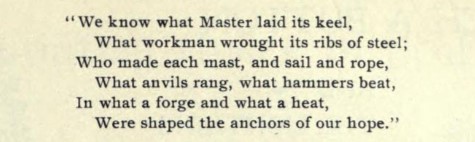
But do you know that the three links of Odd Fellowship which knows no North or South, did much to cement again the ties of our National brotherhood? Do you remember how the G.L.U.S. in 1865 solved the problem of reconstruction? The Grand Sire at the close of hostilities issued a proclamation declaring the unbroken unity of our Order, and in the Session of 1865 delegates from Northern and Southern jurisdictions met at Baltimore and took their seats together in the Grand Lodge. Bishop Hopkins of the Protestant Episcopal Church advised his denomination, rent in twain by the war, “to go to Baltimore and imitate the example of the Odd Fellows.” Yes, thank God, the three links never melted in the flames of war nor rusted in time of peace. God bless the staunch old ship. Odd Fellowship!”
“Brothers, our work is not yet done. While tears are shed, while there are aching hearts, and souls striving for a better life; while there is strife and intolerance and misery and want and woe in the world, we may not forsake our standards.
Let us buckle on our armor anew today! Friendship towards man promotes the contest, the gentle influences of Love supplies the weapons, Truth consecrates the effort and leads to victory.
May our Order live forever, blessing and forever blest, till one law shall bind all Nations, tongues and kindred of the earth– and that the universal of brotherhood!”